Wood: Growth, Direction and the Emotional Life of the Liver and Gallbladder
Within the Five Elements system of Chinese Medicine, wood represents the impulse toward life itself. It is the energy of emergence, expansion and directed movement—the force that pushes a seed to split its shell and reach toward the light. Wood describes how life begins again after dormancy, how intention forms, and how momentum is created. In the body and psyche, this same energy is expressed through the Liver and Gallbladder, the organs that govern flow, decision-making and emotional responsiveness. When Wood energy is healthy, we experience vitality, clarity and purposeful movement. When it is constrained, we feel frustration, tension and anger.
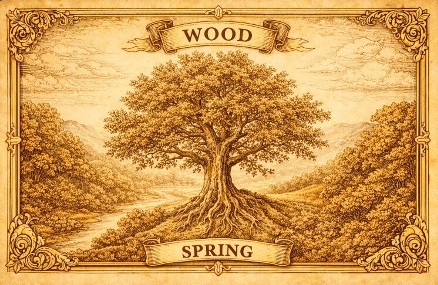
Wood corresponds to Spring, the season of renewal. After the inward stillness of winter, energy begins to rise and spread outward. Sap flows, buds appear, and growth resumes with urgency and direction. In Chinese Medicine, the Liver mirrors this seasonal quality. Its primary role is to ensure the smooth circulation of Qi throughout the body. Just as spring requires unobstructed movement for growth to occur, the Liver requires free flow for physical and emotional health. When Qi moves smoothly, we feel flexible, creative and able to respond to life's demands. When it becomes stuck, pressure builds.
The Gallbladder, paired with the Liver, expresses Wood energy in a more focused way. While the Liver governs vision and planning, the Gallbladder governs decision-making and courage. It is the capacity to act on intention, to choose a direction and commit to it. Together, these organs form the internal architecture of agency: the ability to imagine a future and move toward it. When this system is strong, we feel decisive without being rigid, assertive without being aggressive.
Emotionally, Wood is associated with anger, though this is often misunderstood. In Chinese Medicine, anger is not viewed simply as a destructive force, but as energy that rises. It is the emotional expression of movement being blocked or thwarted. At its healthy end, anger appears as assertiveness, boundary-setting and the capacity to say no. It is the force that allows us to protect what matters and to push back when something is wrong. At its unhealthy extreme, anger becomes explosive, chronic or suppressed, each reflecting a different form of stagnation.
Suppressed anger is particularly significant in relation to the Liver. When emotional expression is habitually restrained—out of fear, politeness or self-protection—Qi can no longer flow freely. Over time, this may manifest as irritability, tension in the body, headaches, digestive disturbances or mood swings. The body, in effect, expresses what the person cannot. In this way, the Liver does not merely "store" anger; it reveals the consequences of energy that has lost its natural outlet.
Springtime is traditionally seen as the season when Liver imbalances most readily surface. Just as nature pushes to expand, so too does internal energy. If the system is flexible, this expansion feels invigorating. If it is constrained, symptoms intensify. Emotional volatility, frustration, and a sense of being easily provoked often point to Wood energy seeking movement. From this perspective, anger is less a moral failing and more a signal: something needs to move, change or be expressed.
The Liver's influence extends beyond emotion into the regulation of rhythm and timing. It governs the smooth coordination of bodily processes, ensuring that systems work together rather than in competition. When Liver Qi is balanced, we experience a sense of inner coherence. When it is not, life can feel effortful, as though one is constantly pushing against resistance. This can lead to impatience, resentment and a feeling of being hemmed in by circumstance.
Crucially, Wood energy is meant to be flexible, like a young tree, it should bend rather than break. Excessive rigidity—whether in thinking, behaviour or self-expectation—can damage Wood just as much as a lack of structure. Healthy Wood allows for adaptation, creativity and responsiveness. It supports growth without forcing it.
Within the wider Five Elements system, Wood does not exist alone. It is nourished by Water, which provides depth and reserves, and it gives rise to Fire, enabling expression and connection. When Wood is deprived of nourishment or overly constrained by other elements, its natural vitality diminishes. Restoring balance often involves restoring movement—physically, emotionally or psychologically—rather than suppression.
Seen through this lens, the Wood element offers a compassionate reframe of anger and frustration. These are not problems to be eliminated, but messages to be understood. They point toward blocked growth, unmet needs or delayed action. When listened to carefully, they can guide us back into alignment with our own forward momentum.
In Chinese Medicine, health is not the absence of strong feeling, but the ability to move with life as it unfolds. Wood teaches us that growth requires direction, expression and the courage to act. When the Liver and Gallbladder are supported, anger transforms into clarity, frustration into movement, and spring becomes not a struggle, but a renewal.